


About the Department:
The Department of General Theoretical Legal and Social Sciences and Humanities traces its origins to the Department of Theory and History of State and Law, established at Kyiv University of Law of the National Academy of Sciences of Ukraine in 1995.
Since its establishment, the Department’s academic staff have included Doctor of Legal Sciences, Professor N. S. Prozorova, Doctor of Legal Sciences, Professor N. M. Onishchenko, Candidate of Legal Sciences, Professor I. B. Usenko (the first Head of the Department), Candidate of Legal Sciences, Associate Professor T. I. Tarakhonych, Doctor of Legal Sciences, Professor O. L. Kopylenko, Doctor of Legal Sciences, Professor O. V. Zaichuk, Candidate of Legal Sciences, Associate Professor O. N. Lvova, Doctor of Legal Sciences, Professor S. V. Bobrovnyk and others. During the University’s structural reorganisation, academic staff from the Department of Philosophy and Social Sciences and Humanities joined the Department.
The Department’s mission is to educate highly qualified, well-rounded professionals with a deep understanding of law, philosophy, sociology and other humanities, who can think critically, uphold ethical standards and act responsibly in contemporary society.

The Department’s Objectives
Our principal educational objective is to deliver high-quality teaching in general theoretical legal subjects, social sciences and the humanities. We integrate current research, practical knowledge and the challenges of our time, taking account of changes in the legal system and emerging developments in the field. Our aim is not merely to impart theory, but to develop the practical skills needed by competent professionals who can respond effectively to changes in law and society.
Our research objective is to advance scholarship in legal theory, philosophy of law, sociology, political science, ethics and cultural studies. The Department supports innovative research approaches, encourages students to take part in research projects and seeks to create an environment that brings together the research interests of lecturers and students. Developing interdisciplinary connections is particularly important, enabling a deeper understanding of social processes through legal and humanistic perspectives.
Our teaching-development objective is to improve teaching methods and introduce innovative approaches to learning. We use contemporary educational technologies to personalise learning, develop students’ critical thinking and bring theory and practice together effectively. Case studies, simulated legal situations, debates and interactive learning technologies make acquiring knowledge more engaging and dynamic.
Our objective in student development is to foster legal awareness, humanistic values and respect for human rights and democratic principles. We seek to educate young people who not only have strong legal knowledge, but also understand the importance of professional ethics. We help students develop a sense of responsibility to society and appreciate the importance of justice and the rule of law.
Our professional objective is to prepare graduates who can apply their theoretical knowledge in practice. Students should be able to adapt to changes in society and the legal system and respond promptly to new challenges. We provide both fundamental knowledge and the practical skills needed to work effectively across different areas of legal practice.
Our interdisciplinary objective is to integrate legal knowledge with the humanities for a deeper understanding of social processes and the role of law within them. We emphasise collaboration between legal subjects, social sciences and the humanities, because contemporary problems require a comprehensive approach drawing on different disciplines. This gives students a fuller picture of a world in which law is important, but is not the only means of addressing social, political and cultural issues.
Today, the Department is a major centre of teaching and research at KUL NASU. Its principal tasks are to help young people develop a modern democratic outlook, provide the knowledge and skills needed for fulfilment in professional and civic life, foster general culture and professional ethics, and develop students’ creativity and capacity for independent learning and personal development.
As a University unit, the Department is primarily responsible for students’ general education, providing substantial knowledge and practical skills across a wide range of subjects. These encompass language training — Ukrainian for Professional Purposes, Business Foreign Language, Specialised Foreign Language, English for Professional Purposes, German, Translation Practice and Latin; social sciences and humanities — Philosophy, Logic and Critical Thinking, Psychology, Sociology, Rhetoric and Public Speaking, Religious Studies, History of Ukrainian and Foreign Culture, and others; and general theoretical legal training — Theory of State and Law, Current Issues in the Theory of State and Law, Canon Law, History of Political and Legal Thought, History of State and Law of Ukraine, Legal Professional Ethics, and others.
The multidisciplinary nature of the Department’s work requires a continuing search for ways to coordinate its academic staff and for the methodological and theoretical foundations that enable it to fulfil its functions effectively. The Department remains responsive to current trends and innovations in education.
Student development is an important part of our work. The Department hosts several academic clubs, mainly in the social sciences and humanities. These include ‘History by Touch’, which explores some of the most influential sources of law in human history, and ‘Latin Readings’ and the Debates Club, which help students improve their language and speaking skills. The Department also organises research, practice-oriented and teaching-methodology seminars, conferences, academic competitions and contests.
Main Areas of Academic and Teaching Development
The Department actively develops and updates educational programmes containing general theoretical, legal and humanities subjects. Curricula and syllabuses are designed to keep educational content relevant to current labour-market needs and changing higher education standards. A key element is a competency-based approach, focused on developing practical skills and the ability to apply theoretical knowledge effectively in real situations.

Providing teaching resources is another important area of our work. Academic staff prepare course resource packages, including teaching guidelines, study materials and assessment questions. The Department adopts modern methods, with particular emphasis on case studies that enable students to analyse real situations, debates that develop critical thinking, and simulations of legal situations that help students understand complex legal processes and make considered decisions.
Digitalisation has a special place in the Department’s strategy. As information technologies develop rapidly, we are creating online courses and learning resources for integration into distance-learning systems, particularly Moodle. This makes teaching easier to organise and education more accessible. Interactive technologies also make learning more engaging and effective, encouraging active participation and independent study.
All our efforts are directed towards developing high standards of academic integrity. Students learn to work independently with scholarly sources and follow ethical standards in education and research. They are taught to use information responsibly, avoid plagiarism and respect intellectual property.
Monitoring educational quality is an important part of our work. Regular analysis of learning outcomes and student feedback helps lecturers adjust their teaching to learners’ needs and expectations. Evaluating the effectiveness of teaching informs improvements in educational quality and supports students’ successful development.
General Information:
- Department name: Department of General Theoretical Legal and Social Sciences and Humanities
- Contact information: Kyiv University of Law of the National Academy of Sciences of Ukraine, 7-A Akademika Dobrokhotova Street, Kyiv, 03142, Room 108.
- Location: First floor of the teaching building.
- Department email: kafztpsgd@kup.edu.ua
- Office hours: Monday–Friday, 9:00–17:00
- Department Management
- Academic Staff
- Department Documents
- Academic Integrity
- Syllabus of educational disciplines
- Syllabus of academic disciplines for 2021/2022

Romanova
Olena MykolaivnaHead of the Department of General Theory of Law and Social Sciences and Humanities, Candidate of Historical Sciences, Associate Professor.
Read more
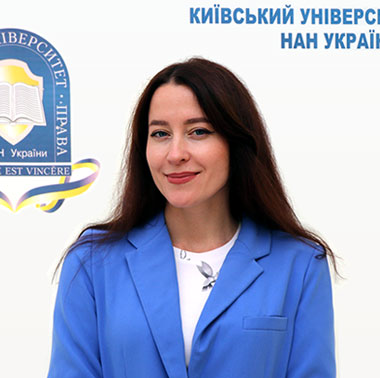
Romanova
Olena MykolaivnaHead of the Department of General Theory of Law and Social Sciences and Humanities, Candidate of Historical Sciences, Associate Professor.
Read more
Serhii
MatvieievAssociate Professor of the Department of General Theoretical Legal and Social Sciences and Humanities, Candidate of Legal Sciences, Associate Professor
Read more
Pavlov
Volodymyr OleksandrovychSenior Lecturer at the Department of General Theory of Law and Social Sciences and Humanities.
Chair of the Labour Collective Council of Kyiv University of Law of the National Academy of Sciences of Ukraine.
Read more
Anzhelika
SolodkaDoctor of Pedagogical Sciences, Professor, Professor of the Department of General Theoretical Legal and Social Sciences and Humanities
Read more
Svitlana
StezhkoCandidate of Philological Sciences, Associate Professor, Associate Professor of the Department of General Theoretical Legal and Social Sciences and Humanities
Read more
Viktoriia
PylypenkoCandidate of Historical Sciences, Associate Professor, Associate Professor of the Department of General Theoretical Legal and Social Sciences and Humanities
Read more
Pashynska
Ahnessa ValeriivnaCandidate of Philosophical Sciences, Associate Professor, Department of General Theoretical Legal and Social Sciences and Humanities
Read more
Liubov
KhomenkoCandidate of Philological Sciences, Associate Professor, Associate Professor of the Department of General Theoretical Legal and Social Sciences and Humanities
Read more
Vakulich
Yana MykolaivnaSenior Lecturer, Department of General Theoretical Legal and Social Sciences and Humanities
Read more




Regulations on the department of general theoretical legal and social and humanitarian disciplines
A meeting of teachers, graduate students and students was held at the Kyiv University of Law of the National Academy of Sciences of Ukraine, dedicated to topical issues of academic integrity and prevention of plagiarism in scientific and educational activities.
During the event, the participants discussed the main principles of academic integrity, the features of creating quality scientific texts, the rules of correct citation of sources, the use of scientific works of other authors, as well as the prevention of textual repetitions and illegal borrowings. Special attention was paid to the legislative aspect of ensuring academic integrity and the history of the formation of relevant norms in the domestic educational and scientific space.
The participants of the meeting emphasized that the observance of ethical and legal standards during the writing of scientific works is an important component of the professional formation of future specialists and the development of modern science. The issue of responsibility for violating the principles of academic integrity was separately considered, in particular the consequences of using plagiarism and other forms of academic violations.
The Kyiv University of Law of the National Academy of Sciences of Ukraine traditionally pays considerable attention to the development of scientific culture, the formation of a responsible attitude to research activities, and the popularization of the principles of academic integrity among teachers, graduate students, and students. Conducting such events contributes to the improvement of the quality of scientific research, the strengthening of academic reputation and the establishment of high standards of education and science.
Actual problems of the theory of the state and law
English language (professional direction)
Foreign language (English)
Foreign language (by professional direction)
Foreign language specialty
History of teachings about the state and law
History of the state and law of Ukraine
History of Ukrainian and foreign culture
Methodology and organization of scientific research
Translation workshop
Problems of the theory of the state and law
Psychology
Theory and practice of translation (business translation and translation of conferences)
Ukrainian language (by professional direction)
Legal psychology
Foreign language (English)
Foreign language (by professional direction)
Foreign language specialty
History of teachings about the state and law
History of the state and the laws of foreign countries
History of the state and law of Ukraine
Methodology and organization of scientific research on the theory and practice of international law
Translation workshop
Problems of the theory of the state and law
Psychology
Court rhetoric and oratory
Theory and practice of translation (business translation and translation of conferences)
Theory and practice of translation
Philosophy of law
Legal deontology and professional ethics
Legal psychology